
Motorcycle Investor mag
Subscribe to our free email news
Vincent Sale
Donington
Auctions, Melbourne, Australia
January 9, 2026
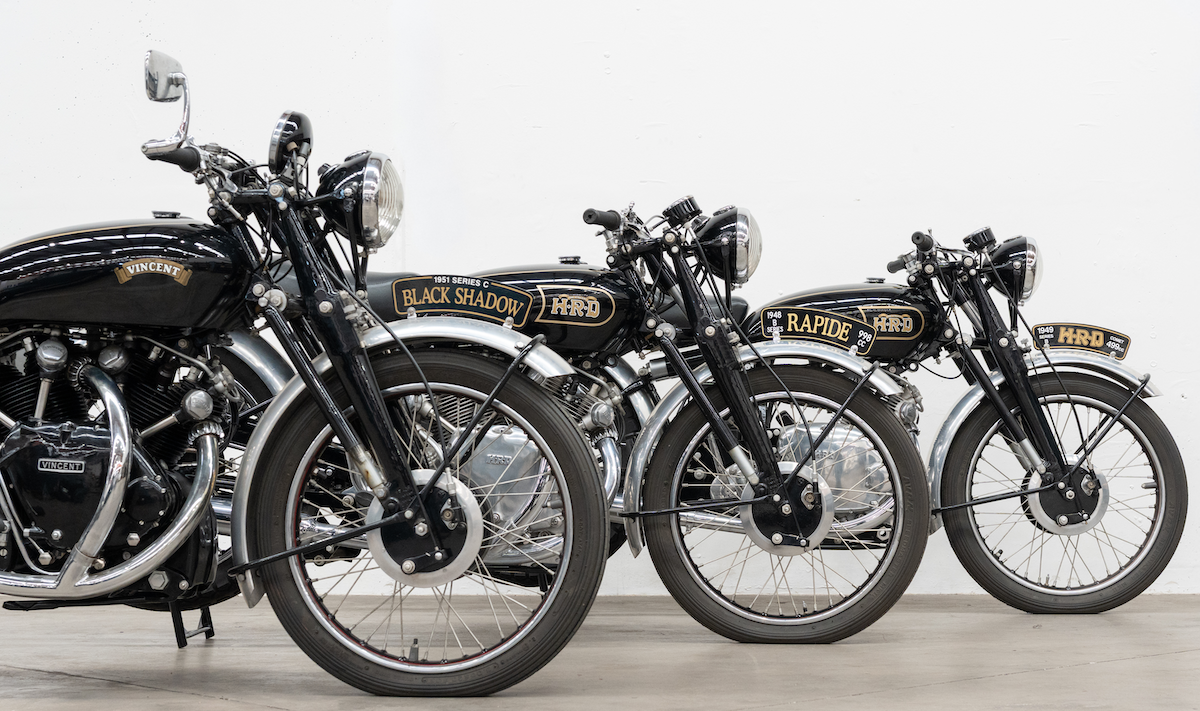
Donington Auctions will next month host the sale of
three Vincents – a Black Shadow, Rapide and Comet –
along with a host of paraphernalia. Here we detail the
motorcycles
Sale date: February 12-23, 2026
See our report on
the previous sale
See the Vincent
Rapide in our shed
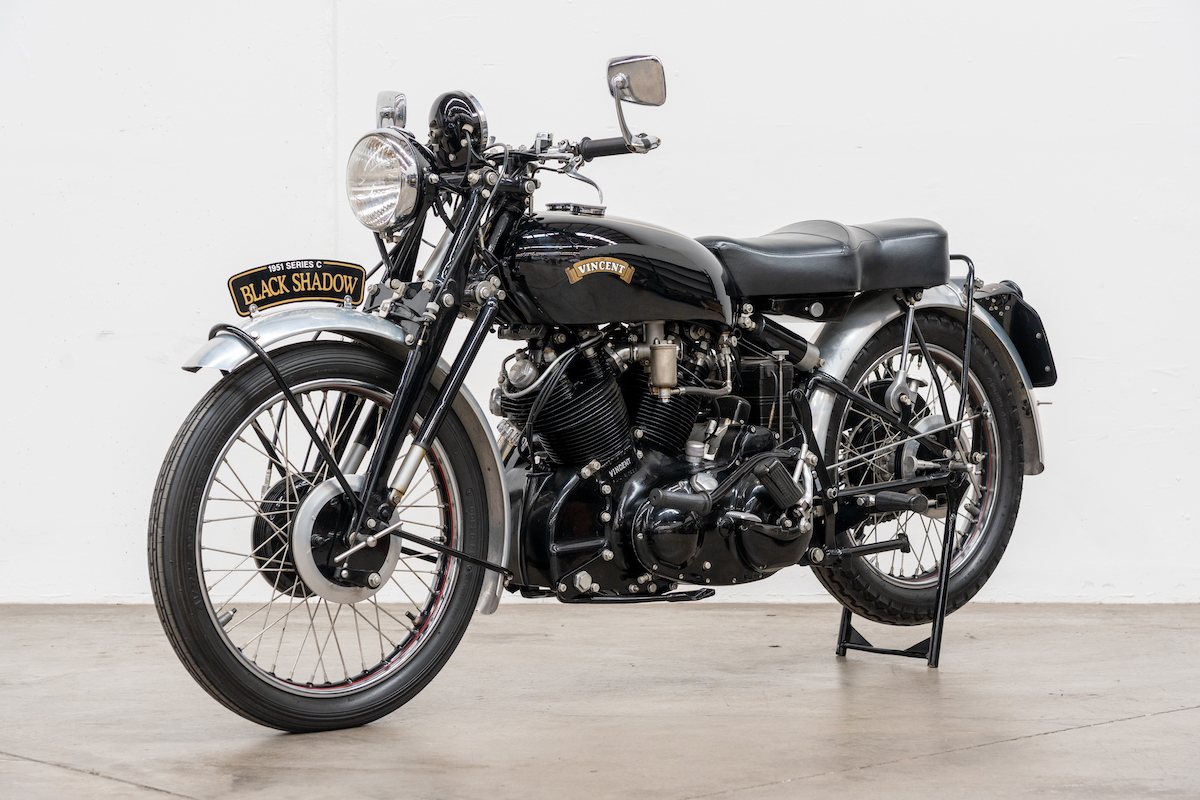
1951 Vincent Series C Black Shadow 1000cc -
Ex Wilfred Guyer of South Australia
Estimate: Au$105-145,000 (US$70-97,000, GB£53-73,000,
€60-84,000)
Eng Number F10AB/1B/7537
Frame Numbers (RFM and UFM)
RC9437B-C Matching numbers
Australian delivered
Introduced in 1948, the Vincent Black Shadow was the ultimate evolution of the company’s celebrated V-twin line. Developed from the Rapide, the Shadow was conceived as an uprated sports tourer — faster, more refined, and technically advanced beyond anything else available at the time.
Its 998cc overhead-valve V-twin engine, already formidable in Rapide specification, was taken to new heights in the Black Shadow. Equipped with high-compression pistons (7.3:1), MkIII cams with quietening ramps (from 1952 onwards), and larger 1⅛" Amal 289 carburettors, the Shadow produced around 55bhp and was capable of exceeding 190 km/h (118 mph). Polished internals further reduced friction and improved reliability.
In addition to its powerplant, the Series C incorporated Vincent’s innovative engineering: the cantilever rear suspension, the distinctive “Girdraulic” front fork combining girder construction with hydraulic damping, and the use of the engine as a stressed frame member. These features endowed the Shadow with stability, comfort, and handling far ahead of its contemporaries. Equally defining was the large 5-inch Smiths speedometer, prominently mounted and calibrated to 150 mph.
Aesthetically, the Black Shadow was unmistakable, with its predominantly black finish and imposing presence, earning it a reputation as “the world’s fastest production motorcycle.” Among road-going Vincents, the Series C Black Shadow is considered the most desirable and highly collectible model. The enduring significance of the marque is also celebrated in the acclaimed documentary Speed Is Expensive, narrated by Ewan McGregor.
Provenance of the 1951 Black Shadow – F10AB/1B/7537
This iconic 1951 Black Shadow, was owned for most of its
early life by Wilfred Guyer of South Australia. Wilfred
was a keen motorcyclist and mechanic who had a long
interest in Vincent motorcycles. Wilfred had documented
that he purchased this motorcycle from a motorcycle dealer
named Murray Mitchel in 1959, the current owner was given
what is believed to be the receipt for that sale. However
we cannot confirm that it is the exact purchase document.
Later Ownership and Condition
The motorcycle was later acquired by a Vincent Owners Club
member, who restored it to a very high standard. This
Black shadow is in running and riding condition, though
some light servicing may still be required before resuming
regular use. It has also won awards at Vincent rallies
across Australia, this motorcycle is a very high quality
Vincent Black Shadow.
Accompanying the sale is an original receipt with the bikes number and some photos of Wilfred Guyer with the machine.
The motorcycle is offered for sale without current registration.
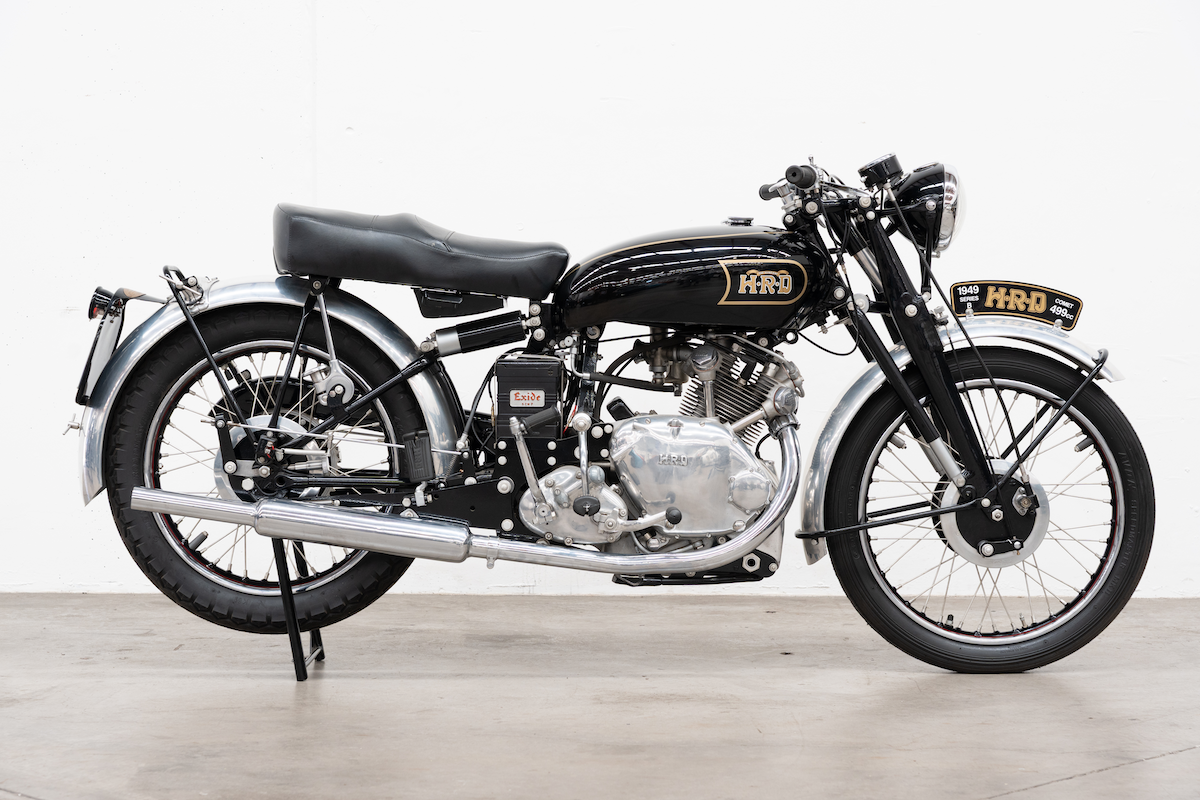
1949 Vincent Series C Comet 500cc - Ex Wilfred Guyer
of South Australia
Estimate: Au$30-45,000 (US$20-30,000, GB£15-23,000,
€17-26,000)
Engine Number:F5AB/2A/2802
Frame Numbers:
(UFM and RFM) RC/1/4702
Australian delivered matching numbers
Rare transitional example
Sold with original registration medallions & VOC
Dating Certificate
Although the first post-war Vincent twin — the Series-B Rapide — appeared in 1946, it was soon joined by a single-cylinder variant in 1948, offered as the Meteor and the Comet. Effectively “half a Rapide”, these singles retained much of the twin’s advanced engineering.
The 499cc Comet engine shared its design philosophy with the Rapide: forward-inclined cylinder, similar valve gear, and a robust bottom end with narrow-sand-cast crankcases. With a 6.8:1 compression ratio, an Amal 229 carburettor, and Lucas K1F magneto, the Comet produced 28bhp at 5,800rpm — enough for a top speed approaching 145 km/h. Power was transmitted via a Burman BAP four-speed gearbox and multi-plate clutch.
The chassis followed twin-cylinder practice, employing the cantilever rear suspension and, importantly, Vincent’s new “Girdraulic” fork in place of the Meteor’s earlier Brampton girder. A dual seat was standard, and while less exotic than the Black Shadow with its ribbed drums, the Comet offered the same refinement, comfort, and innovative construction that made Vincent a household name.
Though the Meteor was short-lived, the Comet proved enduringly popular, remaining in production until 1954 with around 2,000 examples built. More accessible than the larger twins, the Comet provided an entry point into Vincent ownership — combining quality and advanced engineering with a simpler, more manageable riding experience.
This 1949 Vincent Series C Comet is a particularly interesting example from a pivotal transitional period in Vincent history, coinciding with the company’s shift in branding from Vincent HRD to Vincent in 1949 and from Series B machines to the slightly more fined Series C machines. This bike appears to be a very early Series C Comet and displays features consistent with that period.
Provenance of the 1949 Series C Comet
This Particular Vincent Comet came to the current owner in
2010 from the Collection of South Australian mechanic and
Vincent owner Wilfred Guyer. The motorcycle is accompanied
by a history card and photos from the collection of the
owner. This document outlines the motorcycle’s history as
recalled by the owner and provides additional context
regarding its past. The contents of the history card
represent the personal recollections and understanding of
the former owner and are presented for background interest
only.
Examination of the available factory build sheets suggests that this motorcycle may have begun production as a Series B Meteor before leaving the factory as a Series C Comet. Specifically, the carburettor specification originally noted as 1 1/16 inch—standard for the Series B Meteor—was later amended to 1 1/8 inch, which is the standard carburettor size for the Series C Comet. On the same build documentation, the earlier entries appear in darker blue ink, implying that the initial specification pre-dated later revisions. This supports the interpretation that the motorcycle’s specification evolved during manufacture.
Further evidence is found on the engine build sheet, which records a piston marked E7/6 with a compression ratio of 6.4:1. This compression ratio aligns with Series B Meteor specifications. By contrast, Series C Comets were more typically fitted with pistons producing a higher compression ratio of approximately 6.8 :1. This suggests the motorcycle may have left the factory fitted with a Meteor-specification piston despite its final designation as a Comet.
Taken together, the build sheet details and owner history indicate this motorcycle is likely to represent an early factory transition example, assembled during a period of specification overlap rather than strict model delineation—a phenomenon not uncommon at Vincent during 1949.
This motorcycle has been restored to a very high standard and not been started. It has been on static display and will require recommissioning as it has not been run.
This motorcycle is offered without current registration.
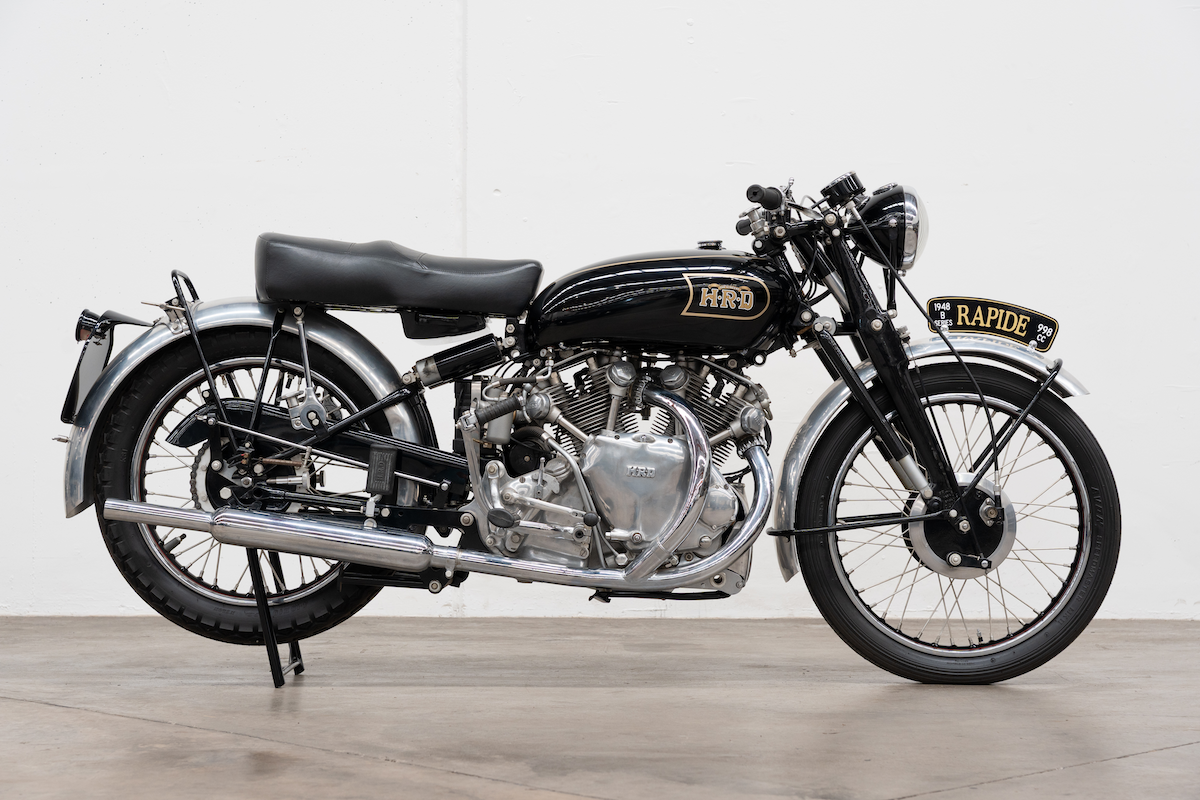
1949 Vincent Series B Rapide 1000cc
Estimate: Au$70-90,000 (US$47-60,000, GB£35-45,000,
€40-52,000)
Engine Number:F10AB/1/956
Frame Numbers: (UFM and
RFM) R2946
Matching Upper and Rear Frame
Introduced in 1946, the Series B Rapide marked a major advancement over its pre-war predecessor, the so-called “plumber’s nightmare” Series A. Central to the design was Vincent’s 998cc overhead-valve V-twin, now employed as a stressed frame member — a radical departure from conventional motorcycle engineering. The addition of rear suspension, virtually unheard of in the immediate post-war years, gave the Rapide a combination of power, comfort, and handling far ahead of its time.
Producing approximately 45bhp and capable of 175 km/h (110 mph), the Series B was further distinguished by its specification: dual 7-inch brake drums front and rear, a 3-inch Smiths speedometer calibrated to 120mph, and Amal 1 1/16" clip-on style carburettors. Clean in its lines and free of the heavier “Girdraulic” forks that characterised the succeeding Series C from late 1949, the Series B is often regarded as the most elegant of Vincent’s post-war twins. Production continued until approximately the mid-to-late 1949, when the Series C Rapide took its place.
Provenance of the 1949 Series B Rapide
The Vincent Rapide currently offered for sale was acquired
by its present owner in 2010. It previously formed part of
the collection of Wilfred Guyer, a respected South
Australian mechanic and Vincent motorcycle enthusiast.
Regrettably, the history of this motorcycle prior to
Wilfred Guyer's ownership remains undocumented.
Like the other Vincent motorcycles included in this sale, this Vincent Rapide has undergone a comprehensive restoration to a very high standard.
According to records held by the Vincent Owners Club, both the Upper Frame Member (UFM) and Rear Frame Member (RFM) of this motorcycle were originally dispatched from the Vincent factory to the dealer Elder-Smith, located in Adelaide, Australia.
However, based on the available documentation, the Vincent Owners Club has indicated that they are unable to authenticate engine number F10AB/1/956. As a result, the engine’s early history cannot be reliably established using existing records. This limitation means that while the provenance of the frame components is well documented, the original details and journey of the engine remain inconclusive.
The motorcycle is offered for sale without current registration.
See our report on the previous sale
See the Vincent
Rapide in our shed
-------------------------------------------------
Produced by AllMoto abn 61 400 694 722
Privacy: we do not collect cookies or any other data.
Top banner pic by the talented Stuart Grant!




Archives
Contact