
Motorcycle Investor mag
Subscribe to our free email news

The fabulous
Vincent
Our bikes – 1952
Series C Rapide Touring
(December 2025, by
Guy 'Guido' Allen)
On the road – at
last! Getting to know our latest and most costly
acquisition has been a little convoluted and
entertaining
It’s been near enough to a year since I first handed
over what seemed like a giant wad of cash for a
motorcycle I had never clapped eyes on, namely the
1952 Vincent Rapide in touring trim. And it’s only in
the last week that it’s been registered on club plates
in sunny Victoria, Australia.
The most exciting part is I’ve now had my third ride
on the monster and am pretty happy with it. Even if it
fell on me…
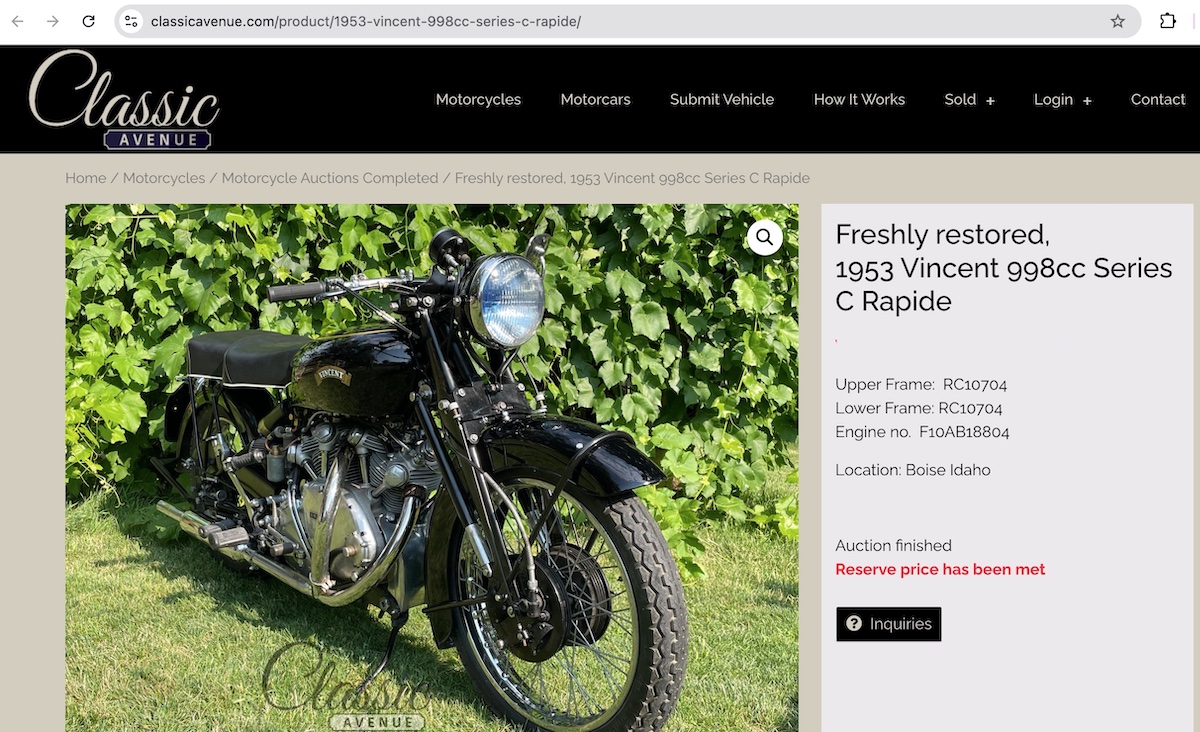
Looking back to late 2024, this thing appears on the Classic Avenue auction
website run out of the west coast of the USA by
a gent called Nick Smith. It’s advertised as a 1953
model, with a fresh restoration that included an
engine rebuild.
The bike was coming out of long-term ownership (since
1980) and failed to reach reserve. While I have never
met Nick, he is well regarded by locals I know and
trust – such as Jon Munn at
Classic Style and author Ian Falloon. Their
advice was Nick is a straight-shooter and good to deal
with. They were right.
So I asked the dangerous
question: how much would it take to buy the bike? The
number was Au$62,500 (US$42,000, GB£31,000, €35,700)
including auction fees. Then you need to add in import
tax and shipping costs – I was told by Falloon that
the best solution was hand over the whole importation
process to Jon Munn, who does it for a living. That
turned out to be great advice.
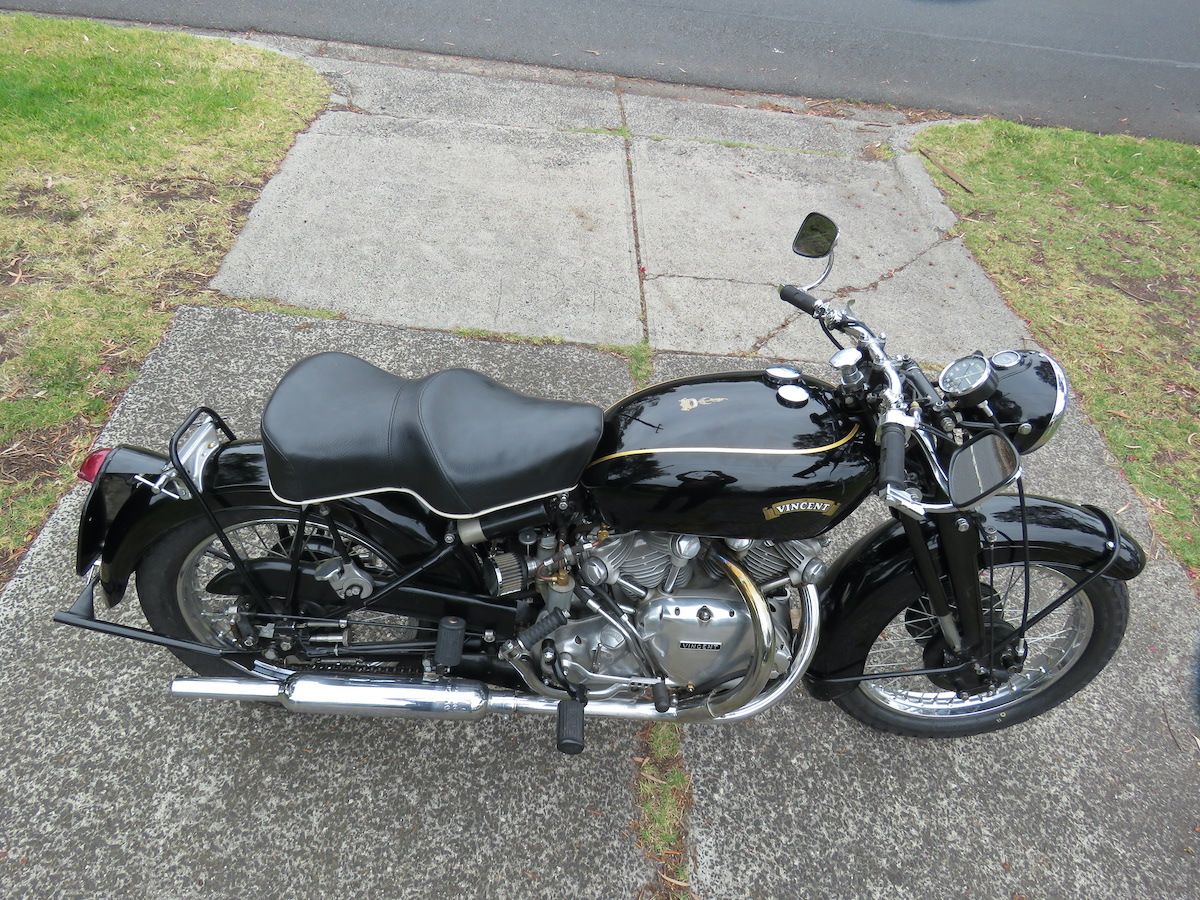
I briefly dithered over the purchase and Nick cheerfully reminded me that even an old man could start it, plus the pin-striping on the tank was done in gold leaf! Cheeky.
Landed, it owed me about
Au$68,000 (US$45,600, GB£34,000, €38,800). A lot of
money, but less than I’d pay for a machine of similar
quality on the local market. That all started just
prior to Christmas 2024 and we lost about four months
through holiday and shipping delays.
Along the way I got in touch with the HRD Vincent Owners Club in
the UK, looking for documentation on my example.
The initial and somewhat spooky response was, “we
thought that bike was in the USA”. It then asked for
photos of assorted numbers stamped into the main and
rear frame, and the engine. Once we got through that
little hurdle, the club was able to provide an
extraordinary suite of documents, including a delivery
docket from 1952 and confirmation the Vincent was in
fact ‘correct’ with all the right numbers ex-factory.
That underpins its value when, eventually, I may have
to pass it on.
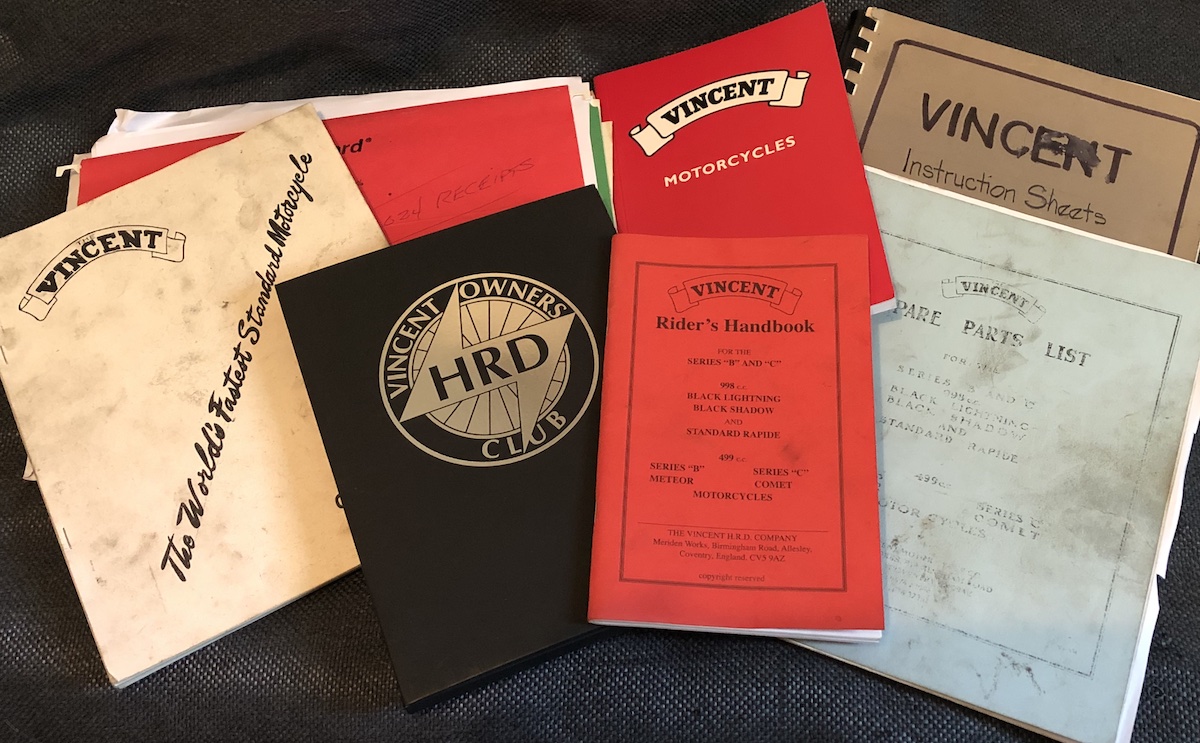
Since we’ve gone down that rabbit-hole, good paperwork is crucial for a motorcycle like this if or when you go to sell it. I’ve put together a physical brief case (yep, really) of paperwork going back 40-plus years, in addition to assorted manuals, parts cattle dogs…you get the gist. Plus there is a comprehensive digital folder.
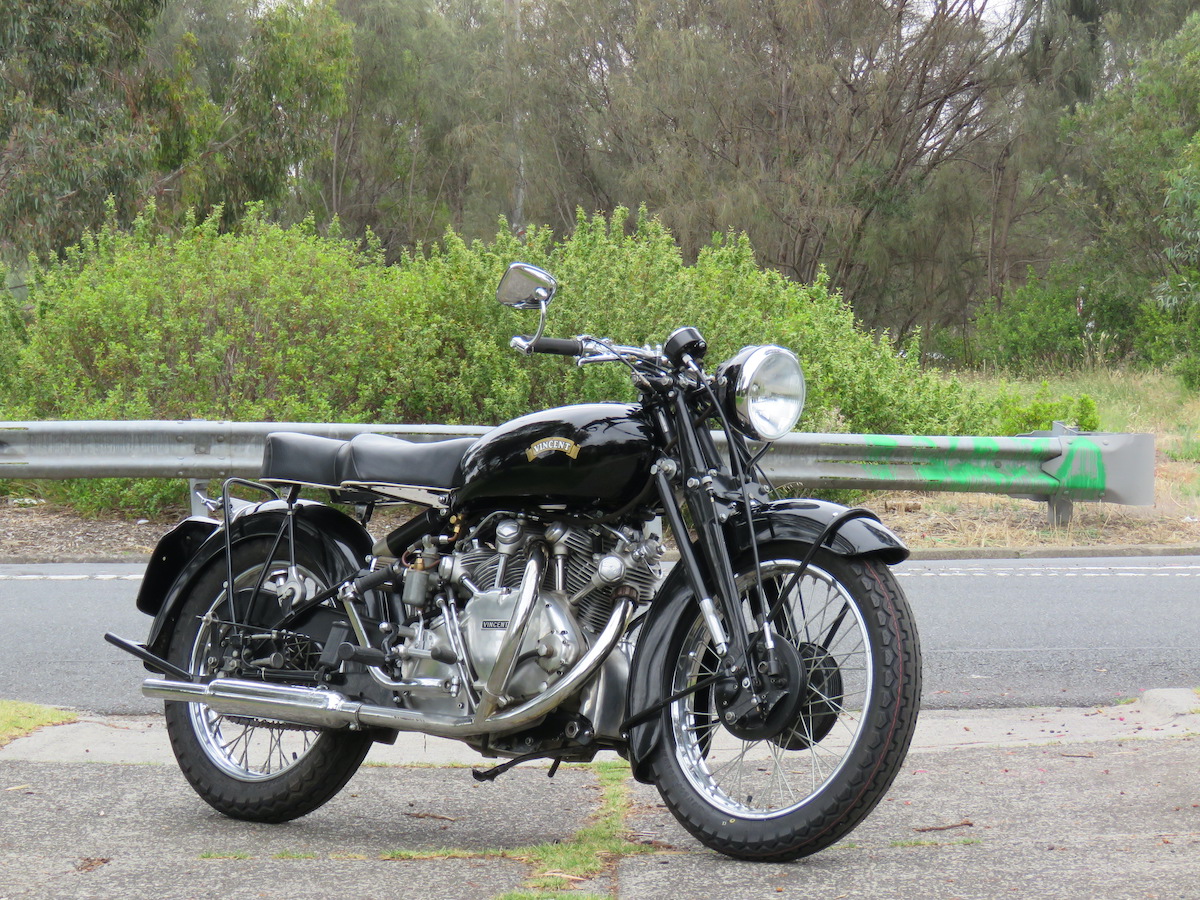
You might notice I
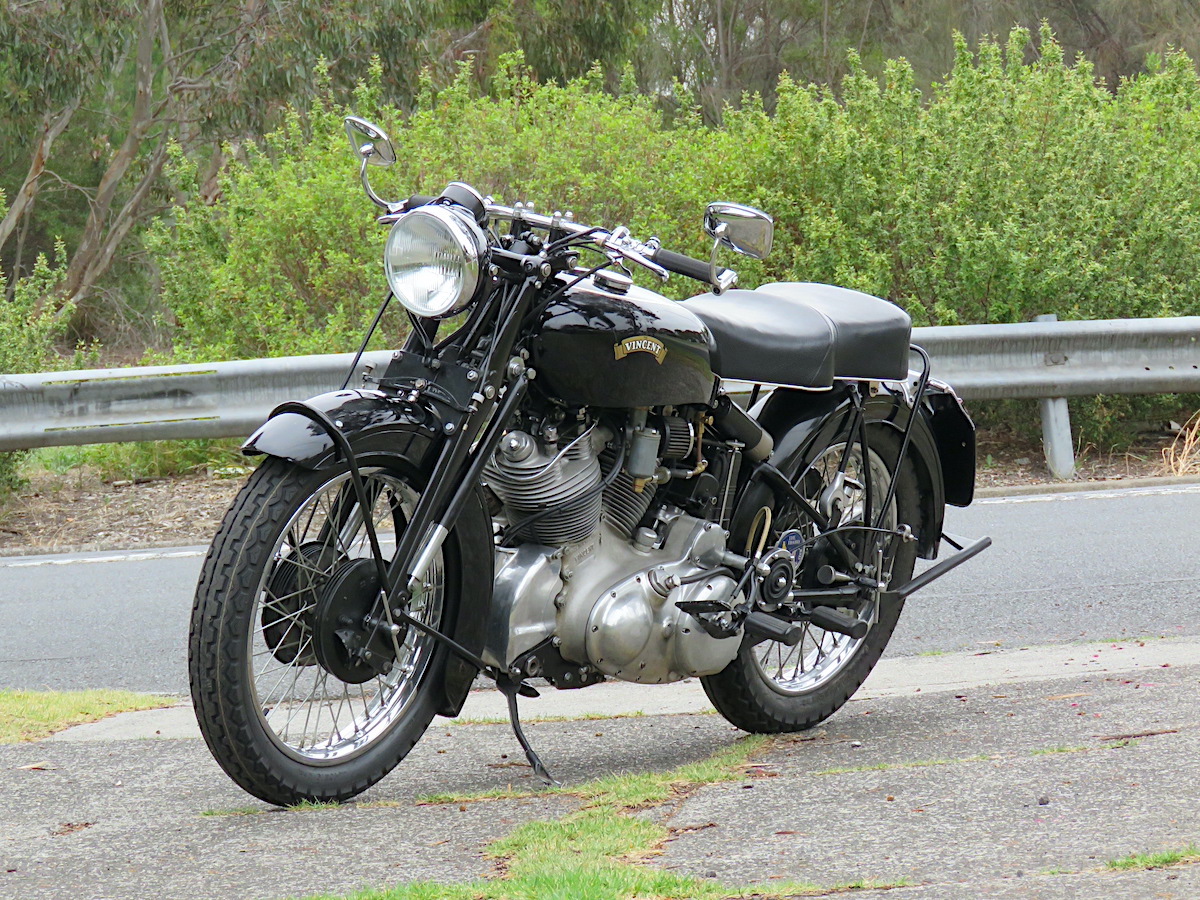
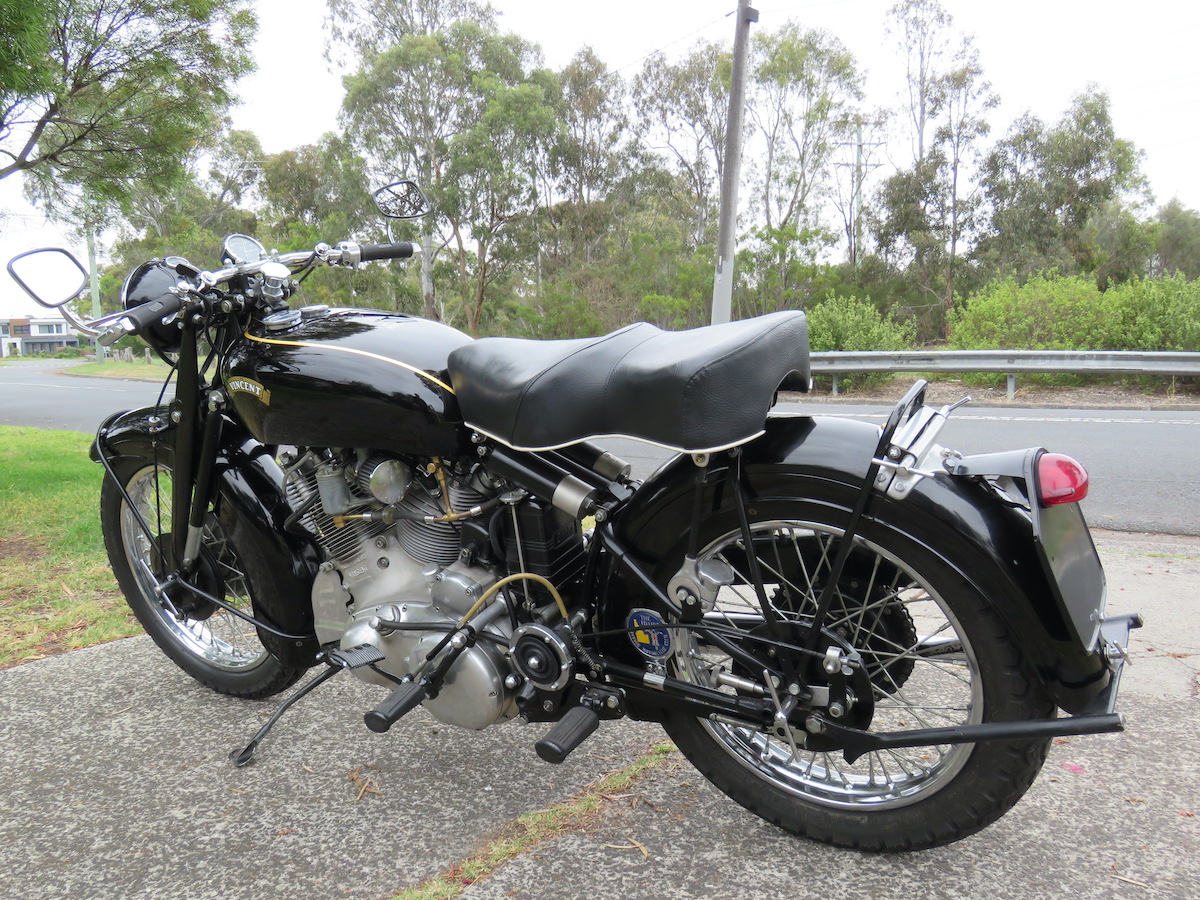
referred to this variant as a touring. It runs the
same engine and chassis as a ‘sport’ Rapide. The
differences are a smaller front wheel (down from 21
inches to 19), deeper valanced guards in black steel
rather than aluminum and taller handlebars (mine has
the 'sport' flat bars). That’s about it. Of course
variations could be ordered from the factory.
When it landed, the motorcycle was fine – exactly what
Nick said it would be. I had a few little issues to
attend to such as converting the headlamp from the
right side of the road to left, oh and fitting new
tyres. The rubber was well-aged, with the front
pre-dating date stamps on the sidewall (!) and the
rear produced about the time ghetto-blasters became a
thing. Dunlop still makes TT100 replica rubber, which
was a perfect replacement.
In any case, I would
have fitted fresh rubber and changed the lubricants as
a matter of course. At least you then have a known
starting point when it comes to servicing. And the
costs are insignificant when compared to the value of
the machine.
Just down the road from me is one of the country’s most-experienced Vincent owners: Phil Pilgrim from Union Jack Motorcycles. Though his business is all about historic Triumphs, he owns the Vincent used for the famous (infamous?) Australian Chiko Roll advertising campaign poster, and has hosted several more. He fitted the tyres, with the proviso I gave him the wheels and not the whole bike.
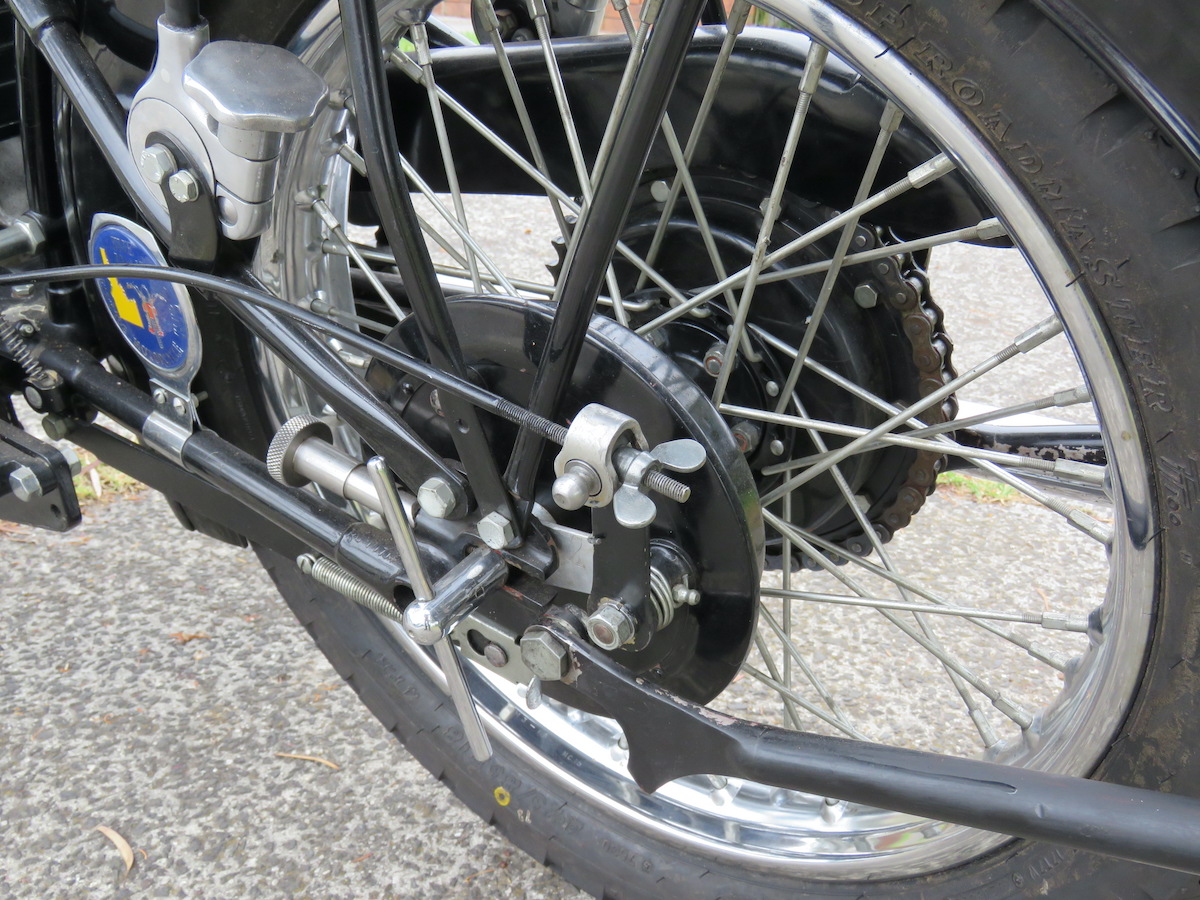
Then I had to learn how
to remove the wheels, which can be done largely
without tools. That’s because the bike is festooned
with Tommy bars – essentially fasteners with giant
handles. Very practical. However you also need to get
your head around completely different architecture
when compared to now – such as dual drum brakes on
both the front and rear, all cable-operated. In the
case of the rear, one of them is nestled in behind the
chain drive. We are dealing with weird cattle.
When you need instructions (and most likely will)
there is plentiful documentation out there, including
factory owner manuals – 70-something years down the
road.
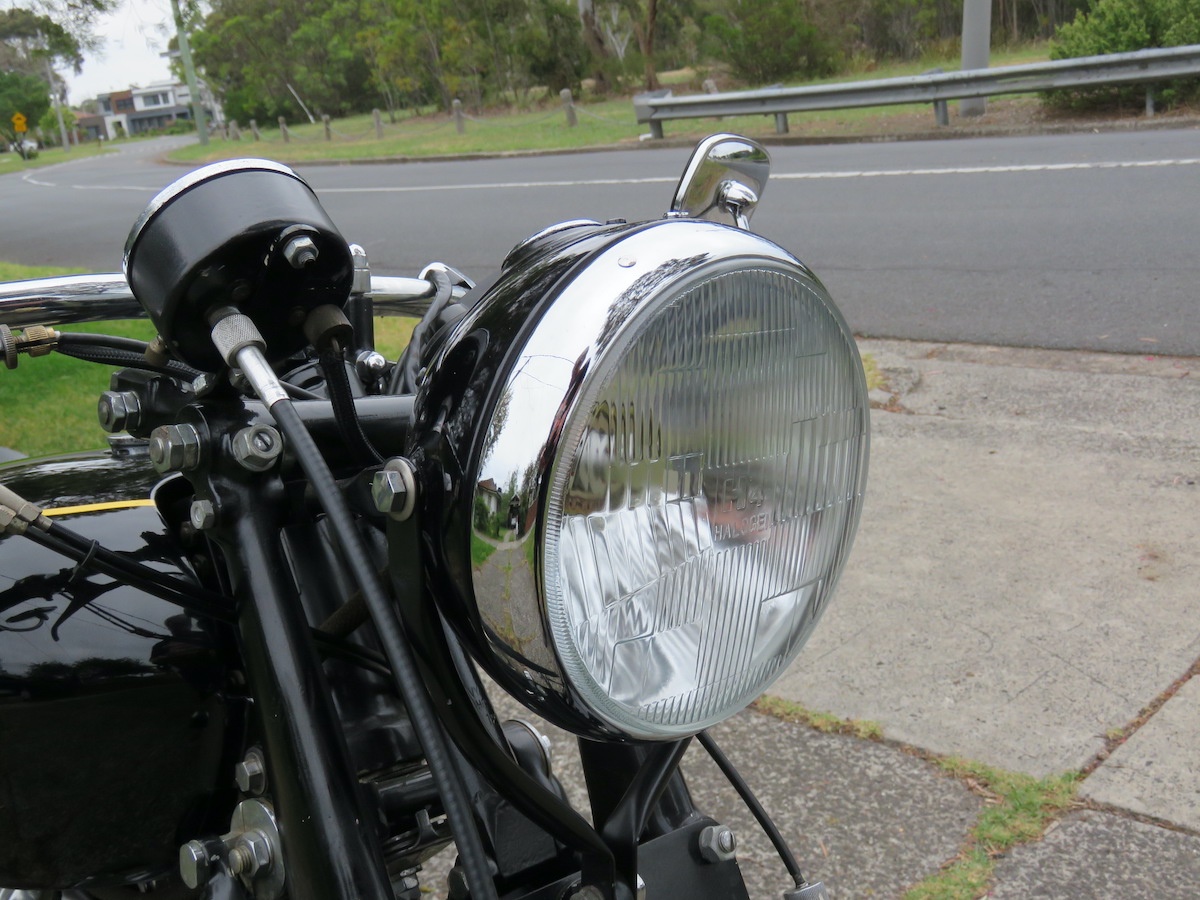
As for a headlamp
exchange, in the short term I’ve simply gone for a
modern lens unit with an LED bulb. The latter was
chosen for its modest draw on a 6-volt generator with
limited resources. I have other more age-appropriate
alternatives in the shed, and will investigate them
later.
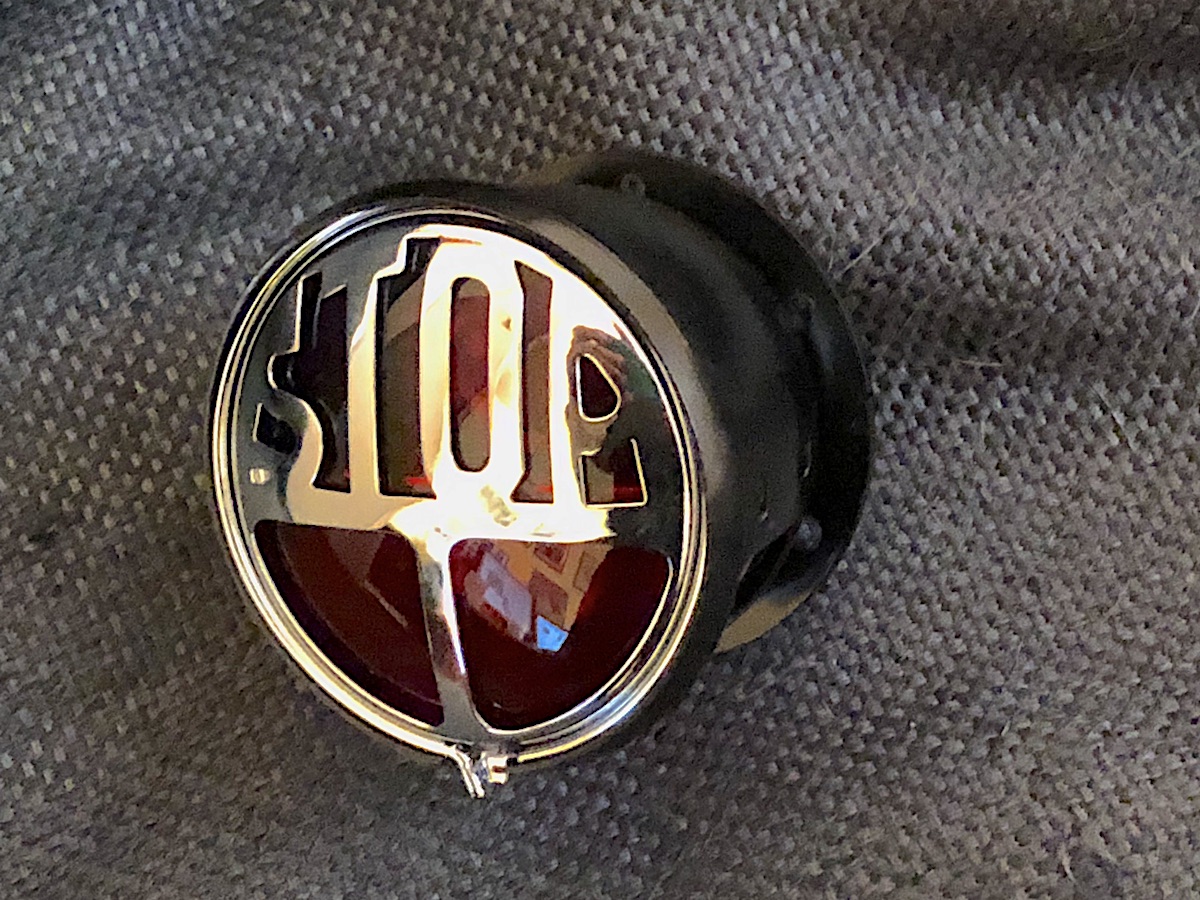
Since we’re on the subject of lighting, this bike is running a Series D rear lamp, which is practical. I left it there for the roadworthy check and will soon exchange it for the period-correct Miller-style ‘Stop’ lamp.
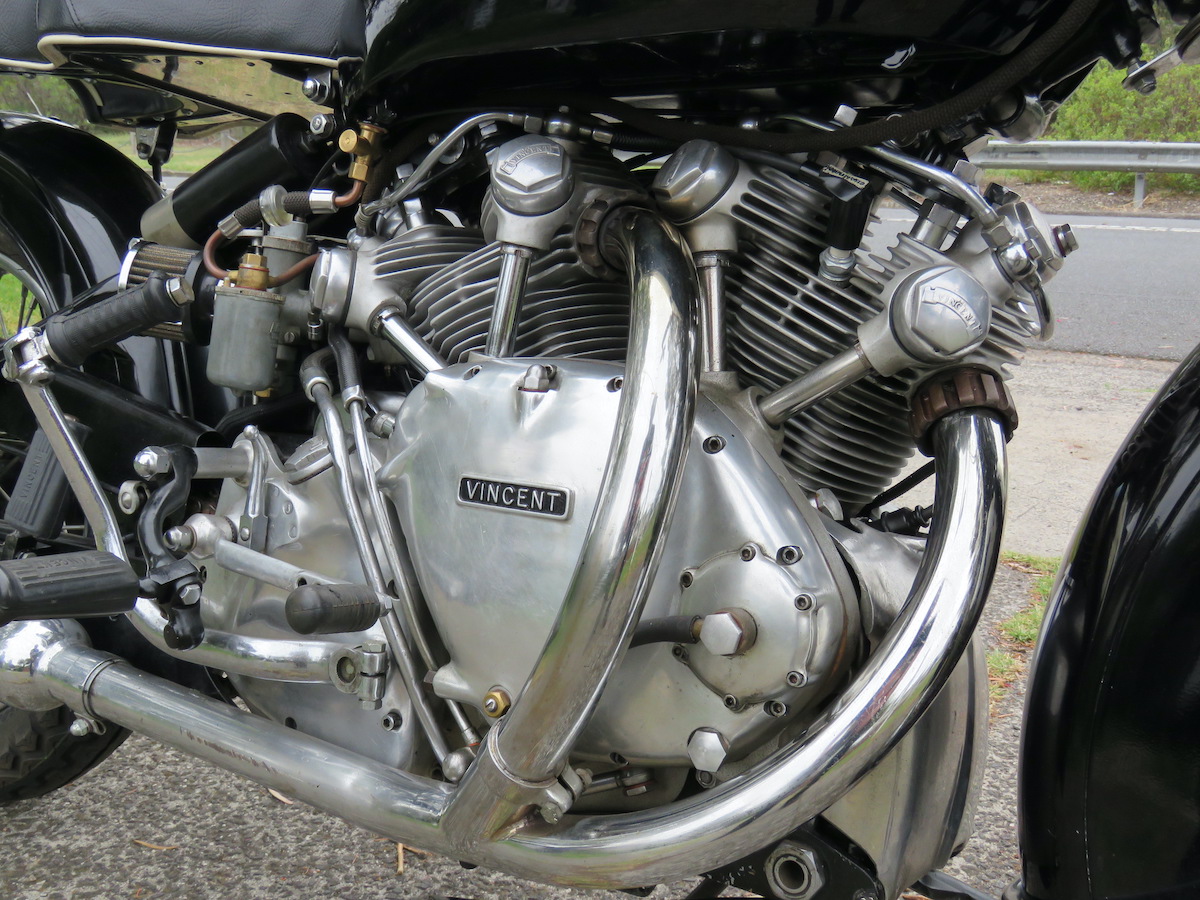
As for starting the thing, it’s usually dead-easy. Because mine is a Series C, it has automatic advance/retard for the ignition and so all you do is flood the twin carburetors with the ticklers and set a little throttle. There is a valve-lifter lever that lets you take it over compression, and then you can swing at the kick-starter. Normally, this one gets going by the third kick. You get that big V-twin rumble which at 58 degrees is very different to anything else out there. Keep the throttle active for a few minutes and it settles into an idle.
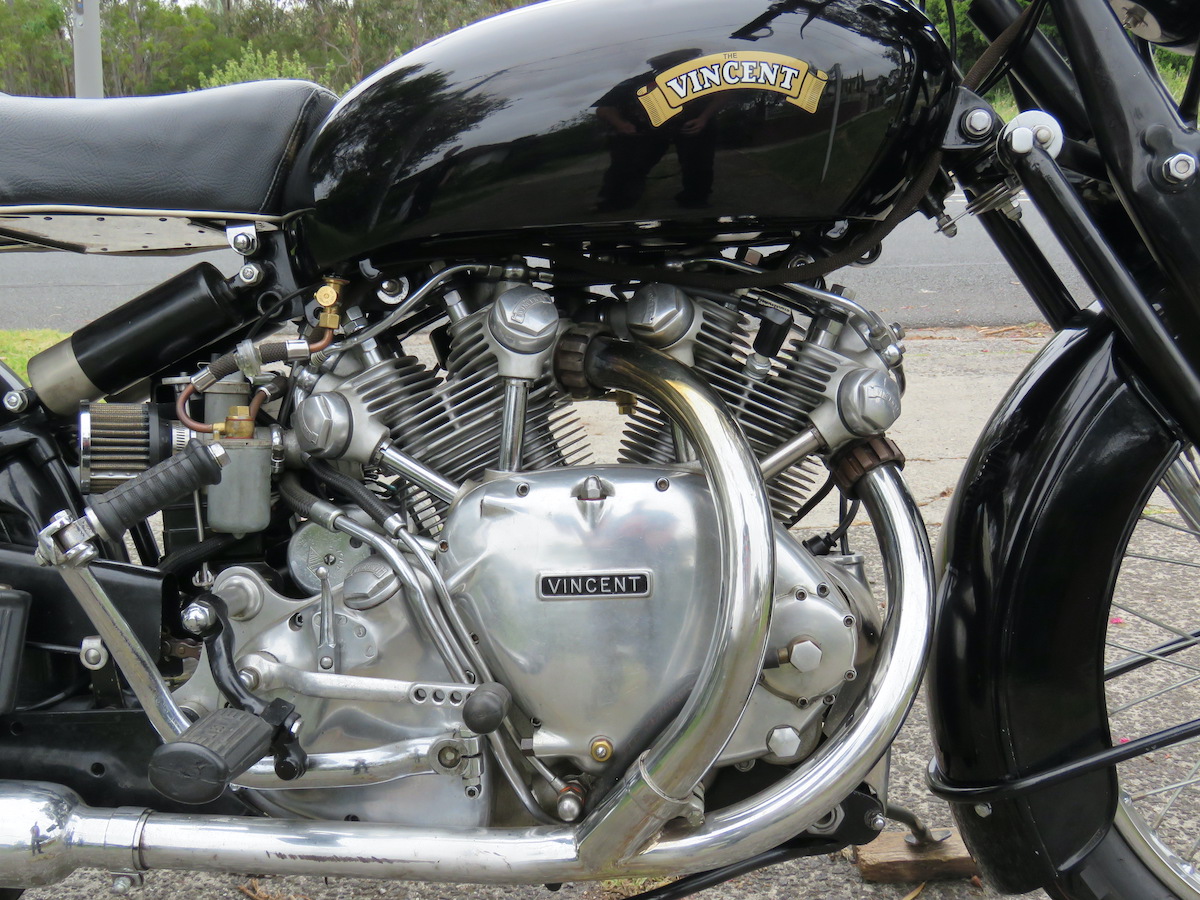
The transmission is typical for the period, with a
one-up and three-down pattern on the right-hand side.
You also have a little neutral-finder lever (which you
use by hand) forward of the gearshift pivot point.
Getting away is standard
1940s to 1950s V-twin, which is you don’t need many
revs and don't worry too hard about finessing the
clutch. Point it in the right direction and cut it
loose, keep rolling into the throttle. That said, the
Vincent clutch is better than many for the period.
There is loads of torque and the entire thinking of
riding the bike is different to a modern equivalent.
I have been fortunate enough to ride a Series B Rapide
out in the country, with no strings attached, maybe 40
years ago. Why that happened is a story for another
day, and I never forgot the experience. I thoroughly
enjoyed it and then had no urgent desire to own one.
But maybe it planted a seed.
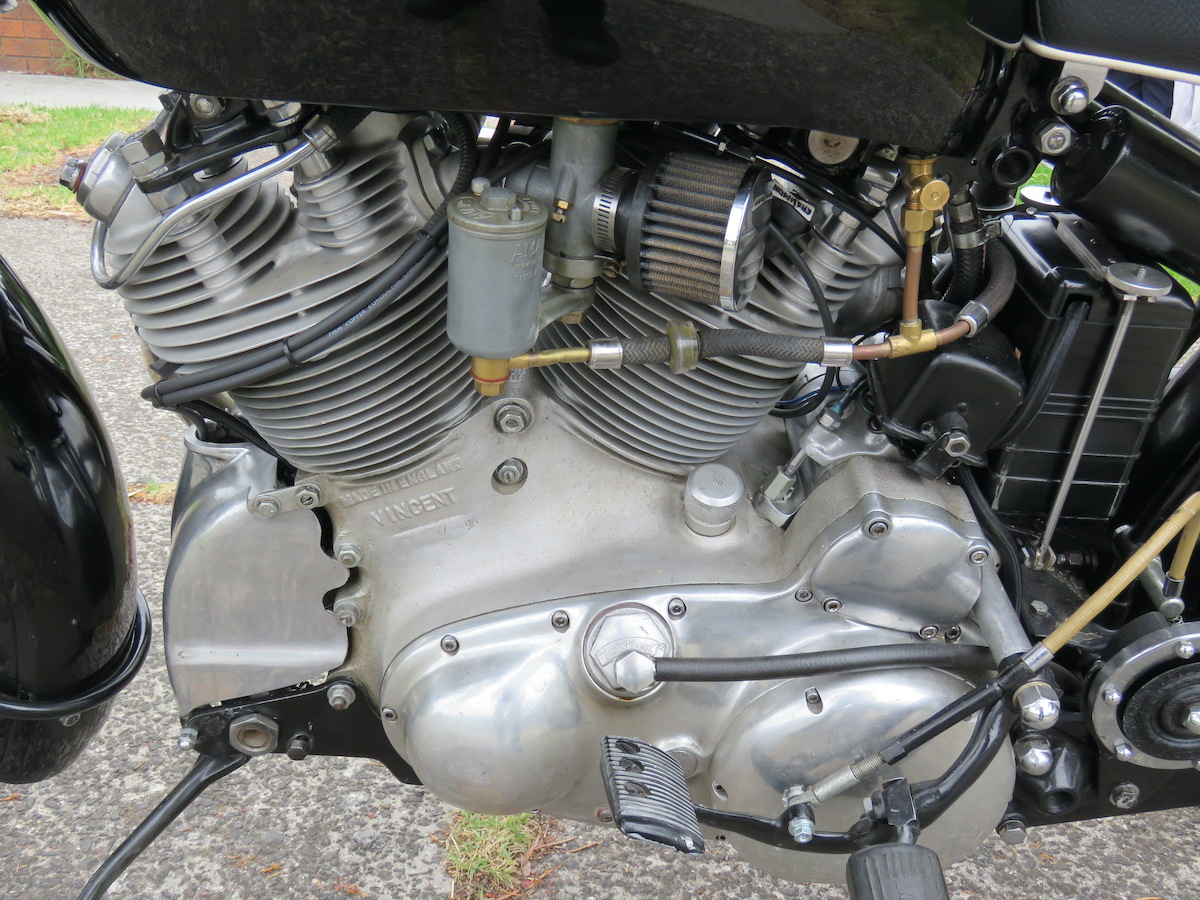
My latest ride got off
to a rough start. The valve-lifter had ceased working
and I suspect it’s because one of the washers for the
cable adjustment had jumped ship. That means you’re
trying to turn it over against compression, of which
this machine has plenty. Combine that with a smooth
concrete workshop floor and a side stand that is iffy
as a kick-start platform and the inevitable happens.
The side stand folds up unexpectedly and Muggins ends
up underneath the Vincent. The good news is the bike
hasn’t a scratch on it. I, however, was limping for
the next few days.
No matter. Go home, get the electric
roller starter (must do a review on that…) and
we got it running. Of course I was worried the damn
thing would stall on the way home, but it didn’t.

I’ve previously owned two 1947 motorcycles: a Sunbeam S7 and Indian Chief (above). They – among other weird purchases – introduced me to low expectations when it comes to braking and handling, and a high degree of rider involvement in the case of the Indian. We’re talking of a three-speed hand-change ‘crash’ gearbox (no synchro) with foot clutch and manual advance/retard for the ignition.
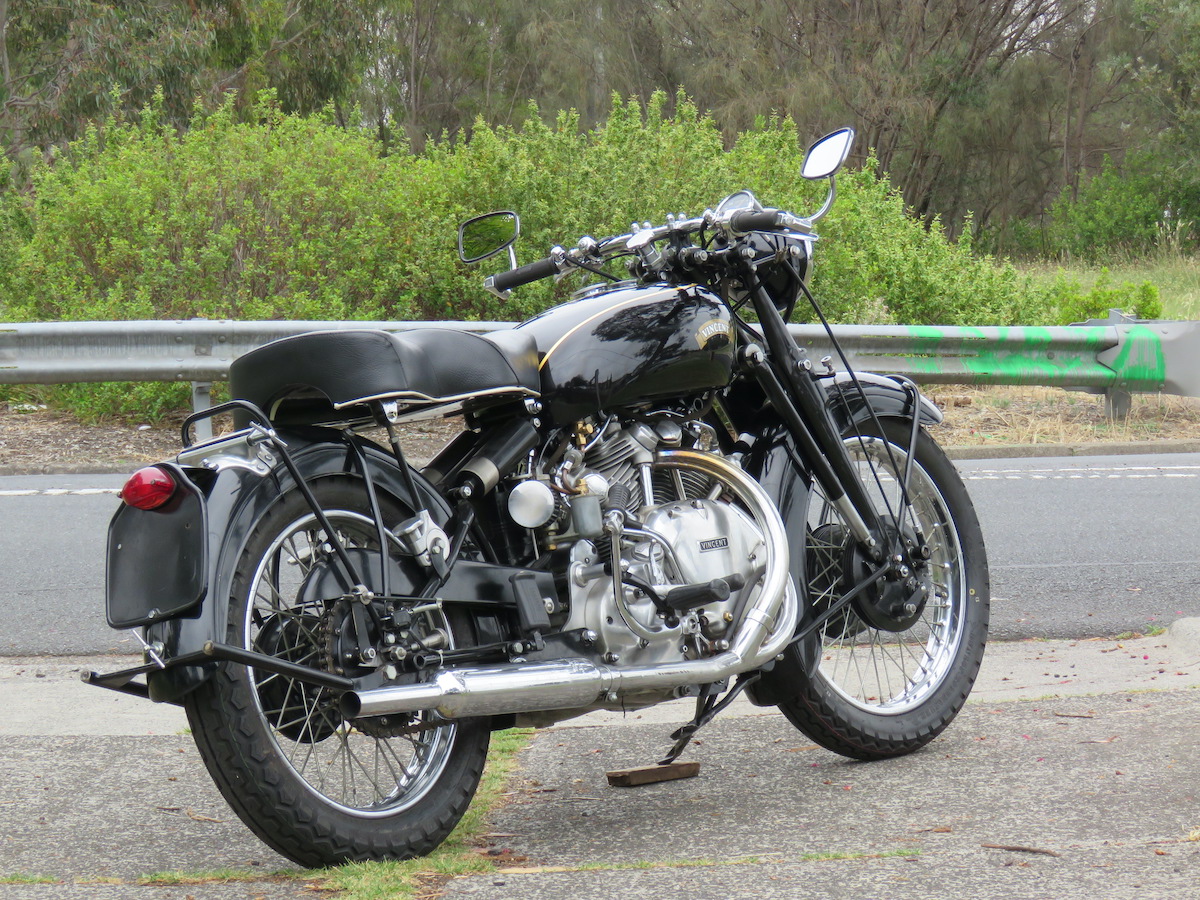
In the light of that
experience, the C-series Vincent is bloody wonderful.
Its transmission is smooth, if slow, and takes a fair
bit of authority to make it from first to second.
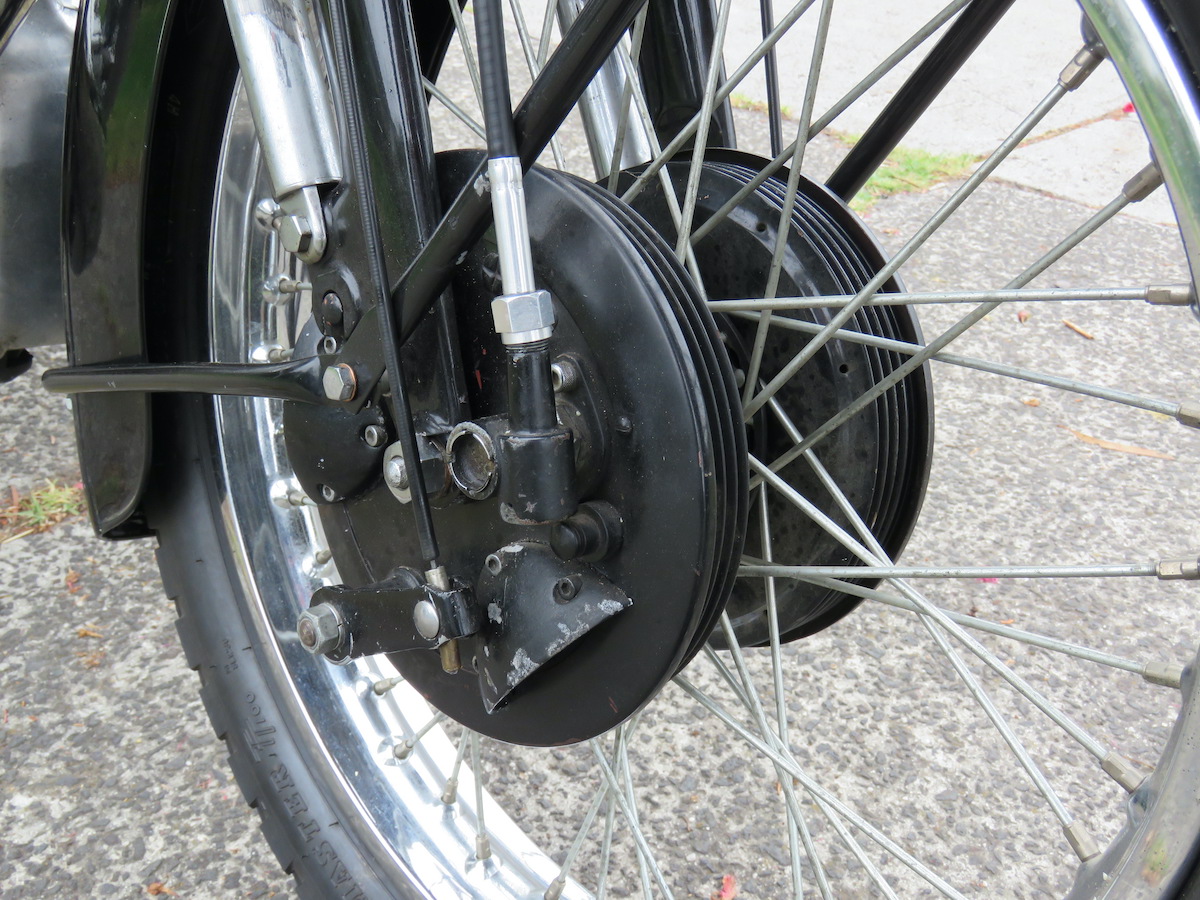
The brakes are decent spec for the era, with dual single leading-shoe drums at both ends. It takes a little care to set them up so they are more or less synchronised and, when they are, they work okay.

The handling is a little
weird by modern standards – it will punish indecision.
This series benefits from having an hydraulic damper
on the front end, aka the Girdraulic.
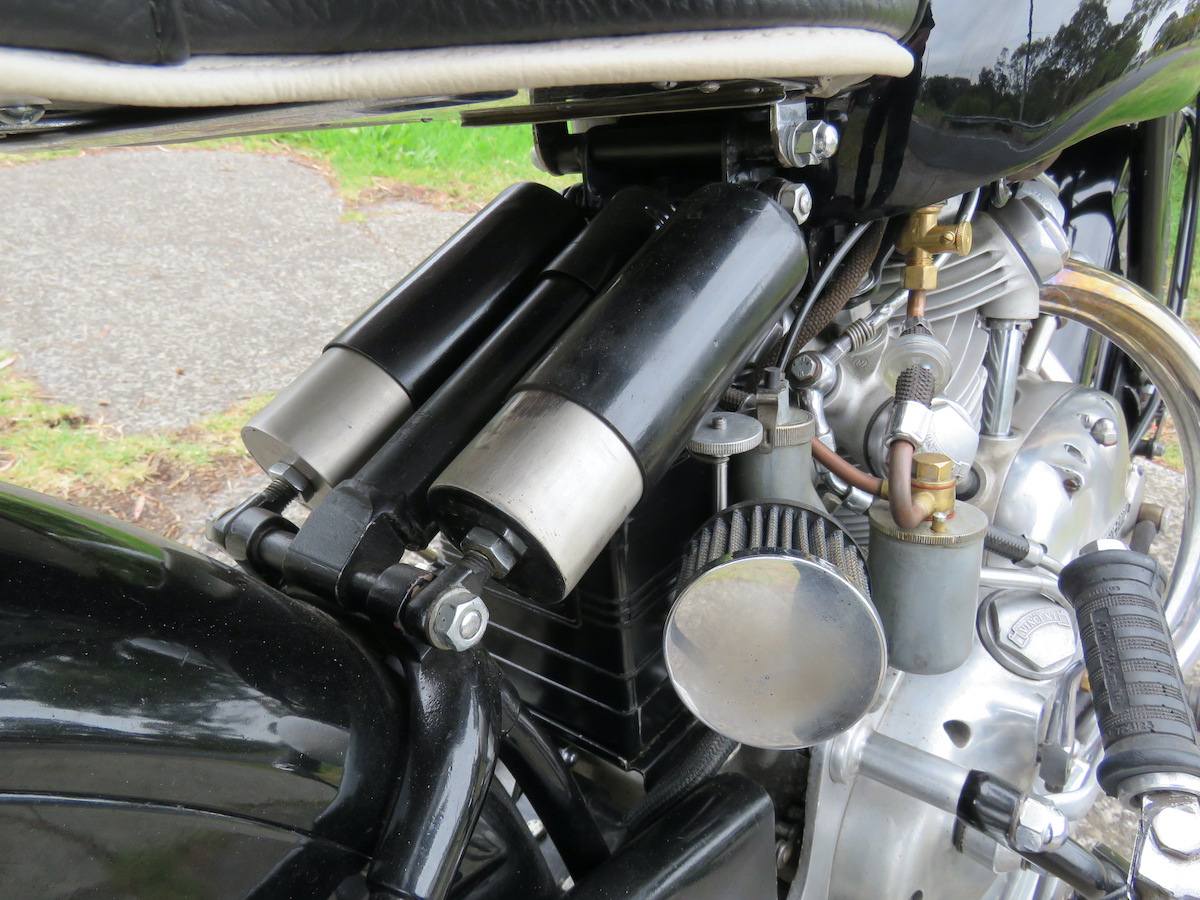
Out back you have a remarkably advanced
cantilever rear end with twin suspension units.
This is one of those
situations where you think ahead – have a corner line
in mind and get into the throttle, knowing you’ll just
have to accept any mid-turn crap. It does pretty well.
You might get the odd head-shake, but confidence is
everything in that situation.
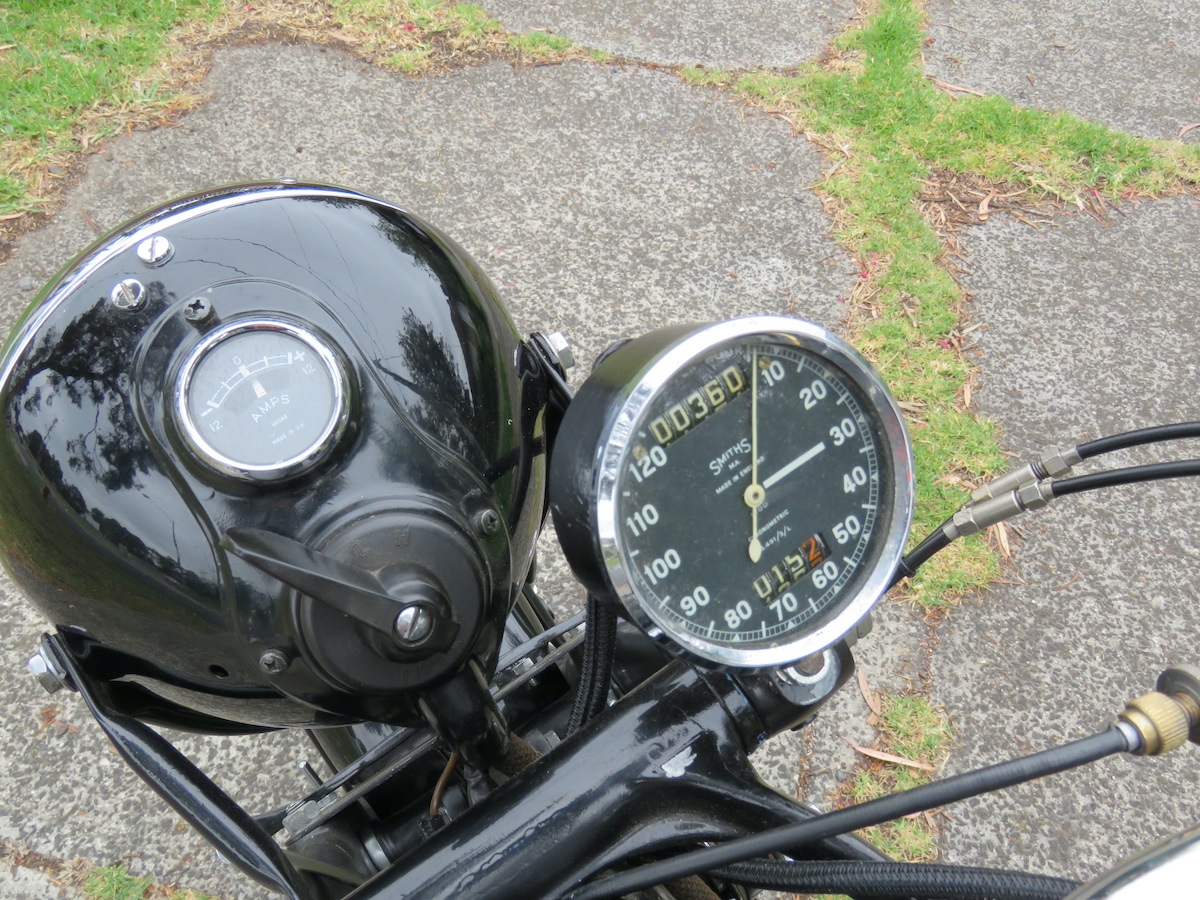
To get speed out of the
thing, we’re talking about building momentum rather
than extreme acceleration. A Rapide runs with about 50
horsepower and is capable of 110mph (180km/h) – it
doesn’t sound like much now, but back then it was
quick. And, as Pilgrim has assured me, it is one of
the few motorcycles of the era which could perform at
a high level for days in a row and come back for more.
Now that we’re getting to know each other, it’s time
to take the relationship to the next stage – a pukka
ride out into the country. Wish us luck…
***
A little more weird cattle stuff...
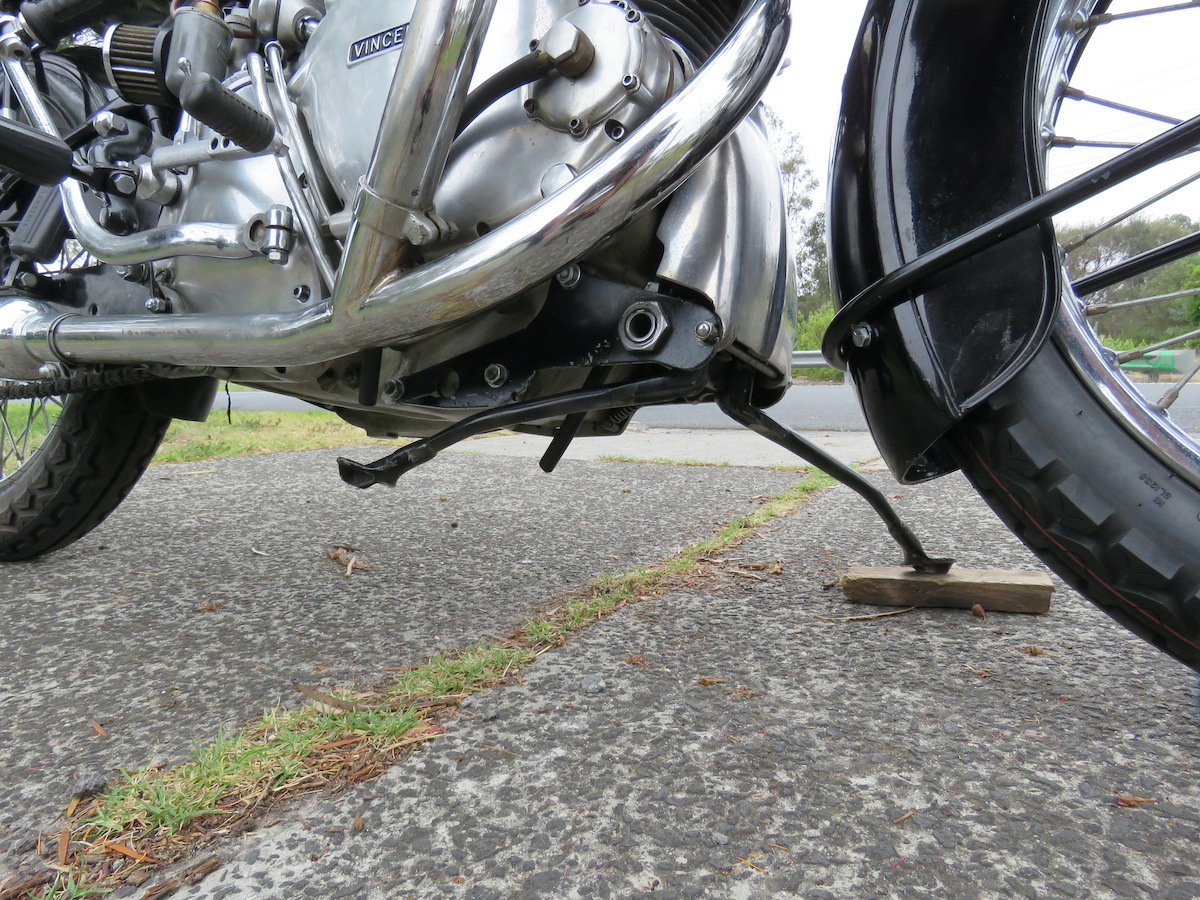
There are two sidestands on the front – one each side – which can be configured to lift the front end off the ground.
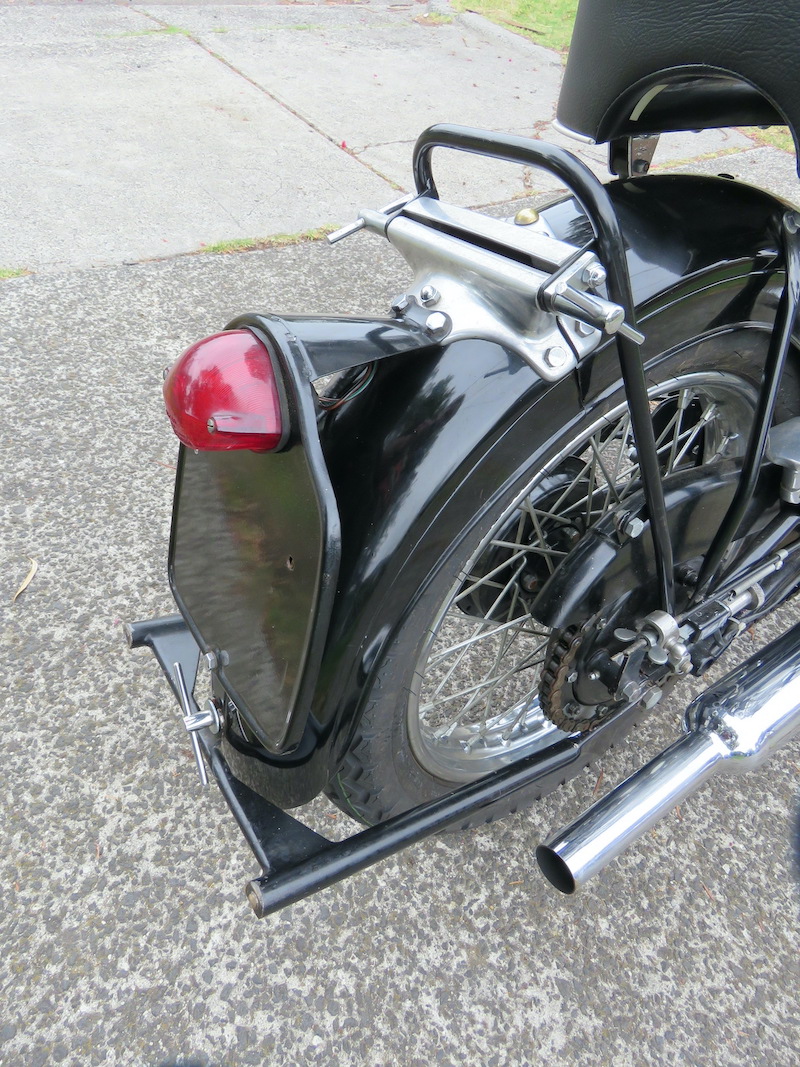
Out back there is another stand to get the rear end off
the ground. Note the hinge in the rear guard to enable
wheel removal.

And we had to leave this badge in place, given it defines
where the motorcycle spent the previous 40 years.
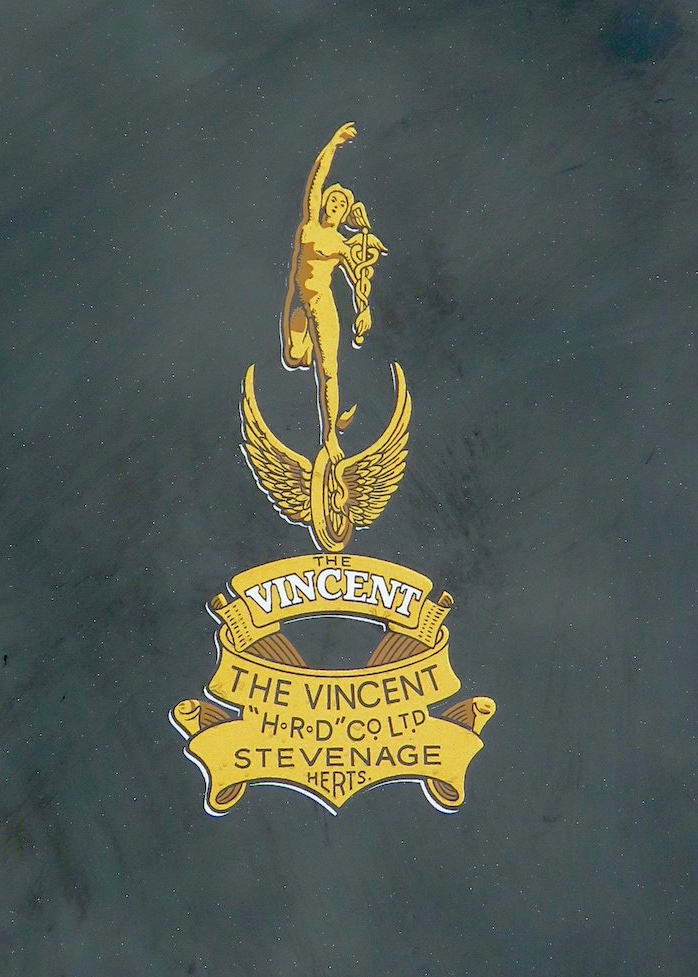
Now that's a fuel tank emblem deserving of admiration...
***
Subscribe to our
free email news
-------------------------------------------------
Produced by AllMoto abn 61 400 694 722
Privacy: we do not collect cookies or any other data.
Top banner pic by the talented Stuart Grant!




Archives
Contact