
Motorcycle Investor mag
Subscribe to our free email news

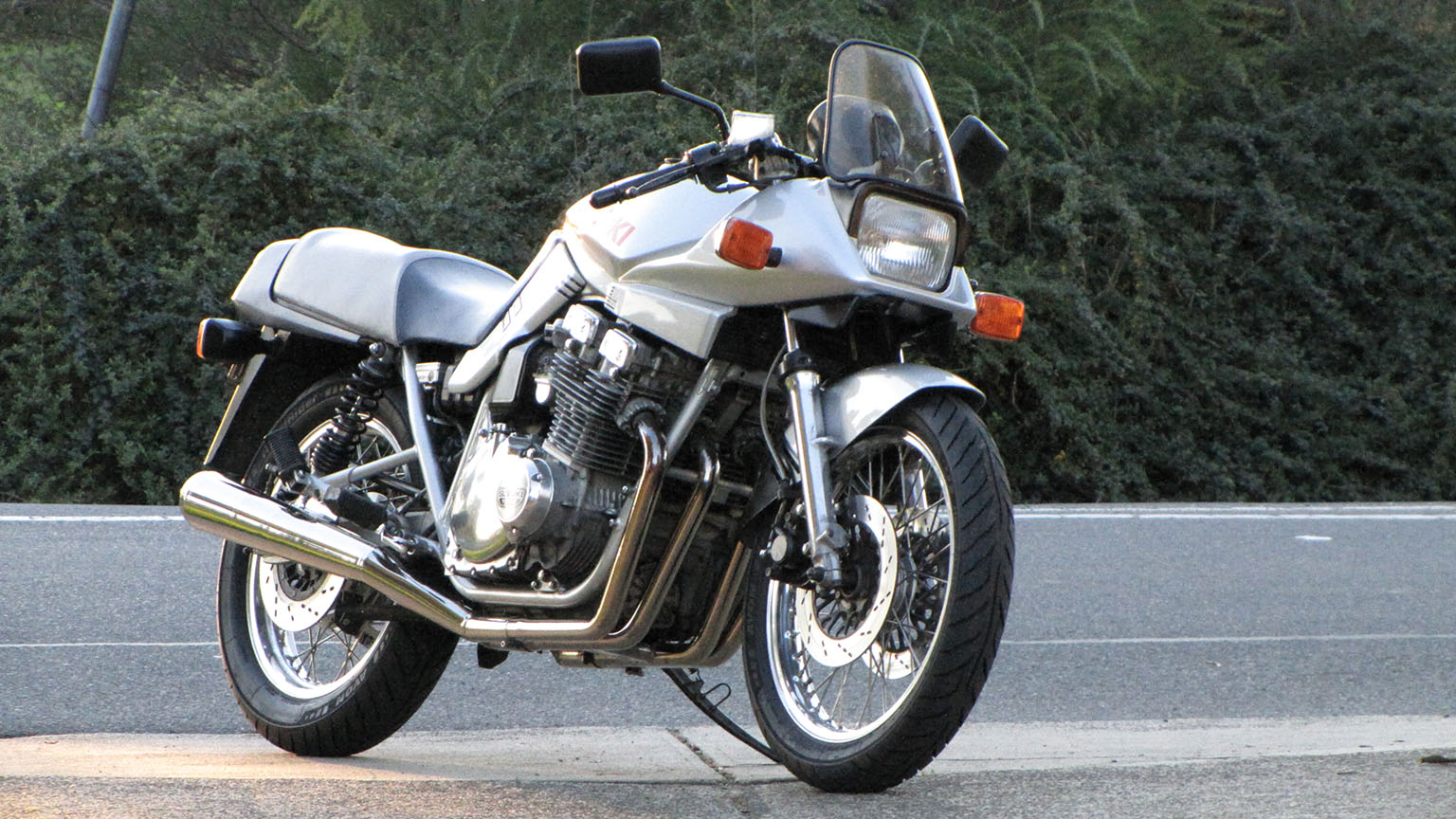
Suzuki Katana 1100
German style and
Japanese engineering

21 August 2026, by Ian Falloon
It could be argued that style often wasn’t considered a priority in motorcycle design until the 1970s. Street motorcycles gradually evolved as form followed function and, apart from a few factory café racers, all motorcycles followed a generic path. BMW changed that with Hans A Muth’s R90S and when Suzuki embarked on their Katana in 1979, they engaged Muth’s Target Design firm to draw up the styling.
Muth and fellow
directors Hans Georg Kasten and Jan Olof Fellström
presented Suzuki with a radical design created through
wind tunnel testing. The rider and motorcycle were
incorporated as a complete aerodynamic package, with
the fairing and fuel tank flowing air over and around
the rider.
See this Classic
Bike Hub feature on Muth.
The first prototype
appeared in April 1980, with an official unveiling a
few months later at the Cologne show. To everyone’s
surprise Suzuki announced the Katana (named after a
Samurai sword) would go into production during 1981,
and so it did, for the 1982 model year.

At a time when other
manufacturers were incorporating liquid-cooling,
rising rate single shock rear suspension, and
experimenting with 16-inch front wheels, the 1100
Katana harked back to the past. The air-cooled 1074cc
four-cylinder engine had double overhead camshafts,
four valves per cylinder, and Suzuki’s TSCC (Twin
Swirl Combustion Chamber) but was still an evolution
of an earlier design. Yet it still produced a
class-leading 111 horsepower at 8500rpm, making the
Katana the most powerful production motorcycle
available.
However, the chassis
lagged behind the engine as beneath the style was a
stock GSX 1100 Suzuki, complete with twin shock rear
end, skinny front forks (albeit with trendy hydraulic
anti-dive), and a 19-inch front wheel. The wheelbase
stretched to 1520mm and the weight was a considerable
232kg.
Intent on winning the
1981 Castrol 6-Hour race at Amaroo Park, Suzuki
Australia ordered 100 6-Hour specials. These were
fitted with 19 and 18-inch wire wheels from the
Canadian-spec version.
The 18-inch wheel was
preferred for racing as there was a wider range of
tyres available and the lower sidewall didn’t flex as
much as the 17-inch. But with the shipment stranded
off Sydney heads due to a tugboat strike the Katana
missed the cut-off date for race entry and the
wire-wheeled Katana didn’t actually race in the
Six-Hour that year.
Ironically Suzuki still
won the 1981 Castrol 6-Hour race, with a GSX1100 shod
with a 17-inch rear wheel! Dave Petersen and Neville
Hiscock were the riders, a lap ahead of Roger Heyes
and Malcolm Campbell on another Suzuki, who in turn
were a lap ahead of third-placed Ron Boulden and
Stephen Gall on a Yamaha XS1100.
See the
Suzuki Japan Katana 1100S page.
Plus the Motorcycle
Specs data and contemporary test page.
And the retro
review from Bennetts in the UK.
We owned one
-------------------------------------------------
Produced by AllMoto abn 61 400 694 722
Privacy: we do not collect cookies or any other data.
Top banner pic by the talented Stuart Grant!




Archives
Contact